Pilates for Hypermobility
Hypermobility is a condition of the joints that affects more people than the majority of the population realizes. Several of my Pilates clients have been somewhat unaware of their hypermobility until I drew attention to it within our sessions and explained the range of motion that each joint is ideally designed to move through.
If you are reading this thinking you or a loved one might have hypermobility, you are in the right place! I like to explain Pilates as the art and science of optimally mobilizing, stabilizing, and strengthening every joint and muscle in your body (hypermobile or not ;)).
In this blog, I’ll answer some of the most commonly answered questions that come my way about hypermobility, how Pilates is designed to help, and how you can optimize your Pilates practice if you happen to be a hypermobile mover.
Blog Guide
- What is hypermobility?
- What are the symptoms of joint hypermobility? Is hypermobility a chronic illness?
- What not to do with hypermobility?
- How can Pilates help with hypermobility?
- What are some key takeaways for doing Pilates with hypermobility?
What is hypermobility?
Hypermobility is a joint condition where some or all of a person’s joints move excessively, past a “normal” range of motion.
What are the symptoms of joint hypermobility? Is hypermobility a chronic illness?
You might be hypermobile if you can straighten your elbows past a neutral position, extend your pinky fingers away from you past 90 degrees, or straighten your legs with your hands on the floor. These signs are outlined in more detail by the Beighton Score at the Cleveland Clinic.
More signs and symptoms are outlined here.
While hypermobility itself is not known as a chronic illness, it is associated with conditions such as hypermobile Ehlers- Danlos Syndrome, which is a connective tissue disorder that can result in joint pain (clicking), easily bruised skin, extreme fatigue, and very unstable joints.
Nonetheless, regardless of whether or not you have EDS, hypermobility alone can easily lead to a variety of different injuries and joint pain due to the lack of control and potential weakness in the surrounding muscles of your joints.
Illness is a pretty extreme word, so I’d steer clear of labeling yourself with an illness due to your joints and how they move. Hypermoblity is more so a chronic joint condition that might be coupled with other aspects of your health, such as EDS.
What not to do with hypermobility?
If you have hypermobility, I advise that you avoid passively hanging out in the end range of your joints for extended periods of time. If you have hypermobility in your knees, for example, I’d advise you to micro-bend your knees if you will be standing for prolonged periods of time.
Less is more the majority of the time when we are fine-tuning strength and control in the muscles around our joints.
If you are working out in a traditional gym setting, restrain yourself from putting uncontrolled load (weight) and force into your fully extended joint range. For example, if you are doing squats, when you stand up try to keep your spine neutral, instead of swayed forward, and your knees microbent instead of locking out and hyperextending.
Likewise, if you are working on your upper body, restrain yourself from throwing your body into excessive elbow hyperextension during a tricep kickback or shoulder hyperextension (reaching your arms excessively far behind you) when doing a lat pull down.
How can Pilates help with hypermobility?
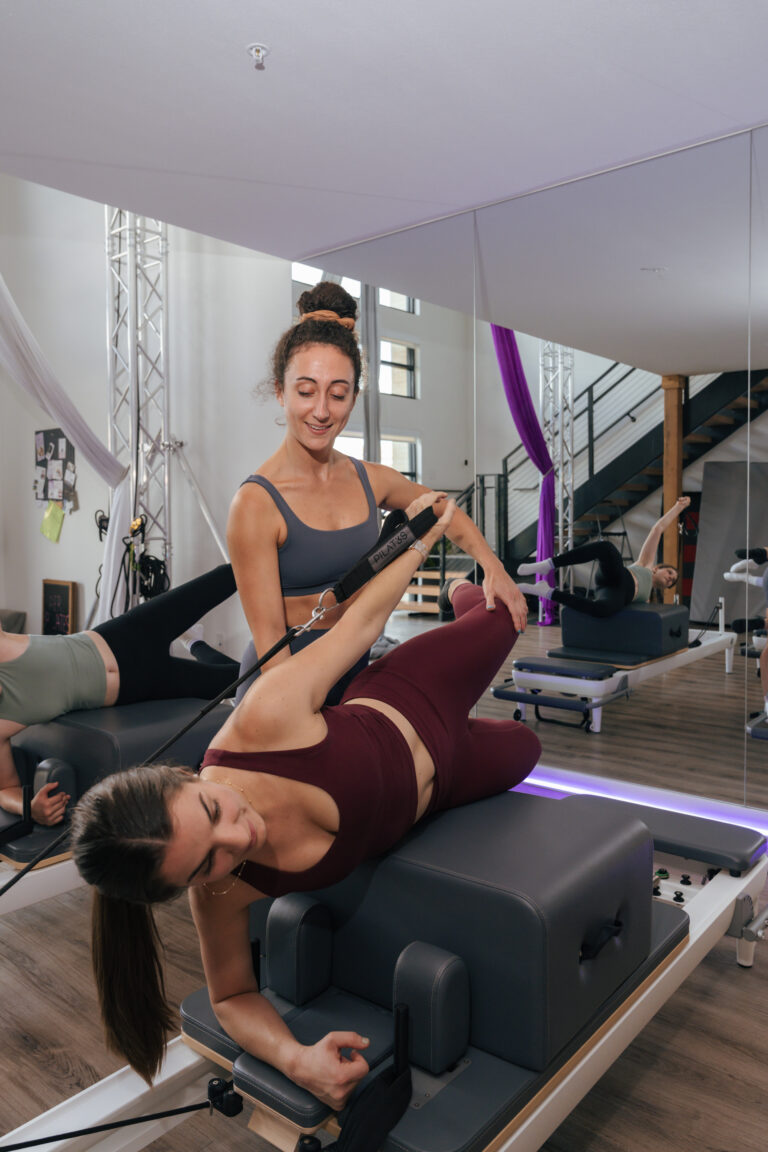
Pilates is widely known for helping with hypermobility. By functionally strengthening the muscles and tendons around each joint, Pilates can help a hypermobile person establish more control, and sustain motion around each joint. This makes it so you don’t “dump into” your joint’s end range, and lock-out, as explained above.
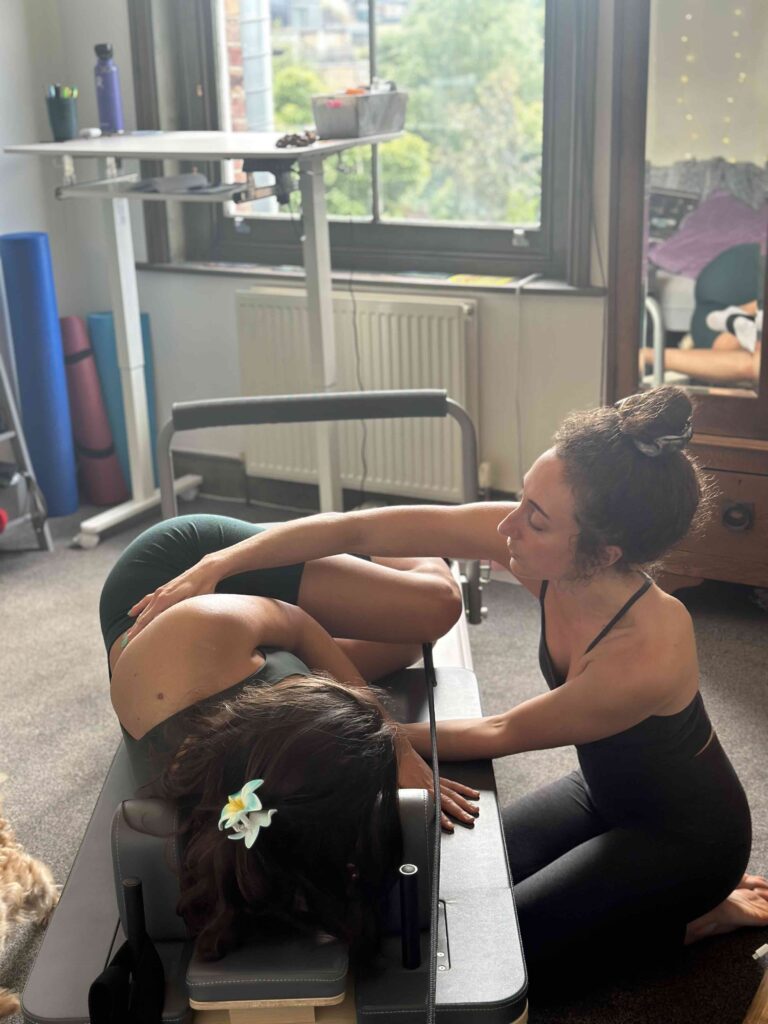
Pilates is also known to be massively beneficial in helping improve proprioception for all people (not just those who are hypermobile!)
Proprioception is your awareness of your body in space. Those who have hypermobility tend to have a lot less proprioception because of the fact that less proprioceptors inhabit your muscles and tendons (connects muscles to bones), and ligaments (connects bone to bone).
On a nerdy note, proprioceptors include cells called mechanoreceptors, golgi tendon organs, and muscle spindle fibers. By functionally strengthening your body through Pilates, you will slowly work to increase your body’s deposit of these proprioceptors, therefore, increasing your awareness of your body in space.
When you have a greater awareness of your body in space, you will be less likely to lock out into your hyperextension and will see improvements in your balance.
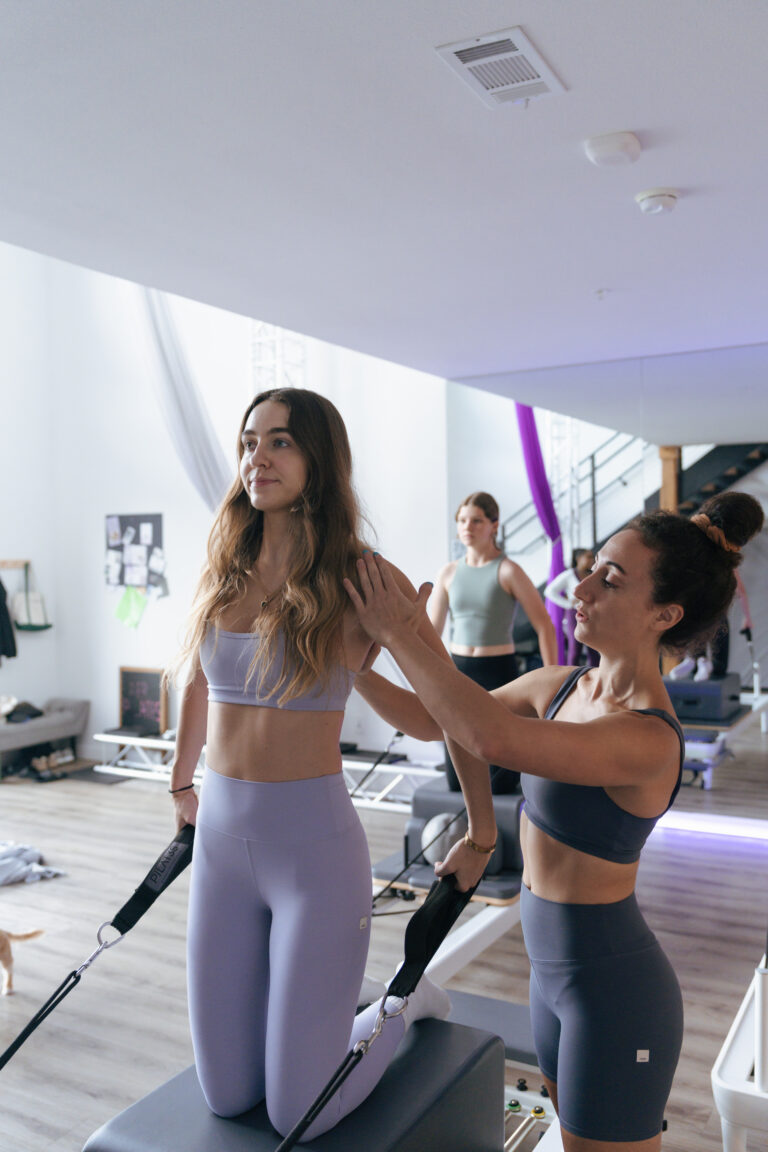
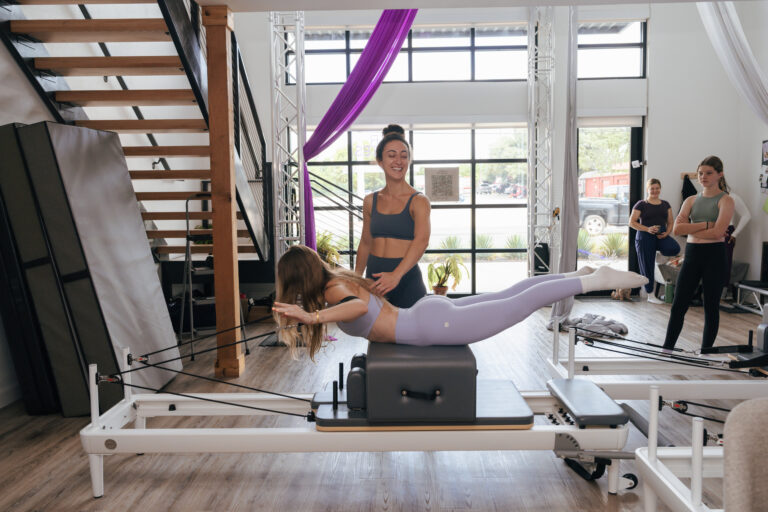
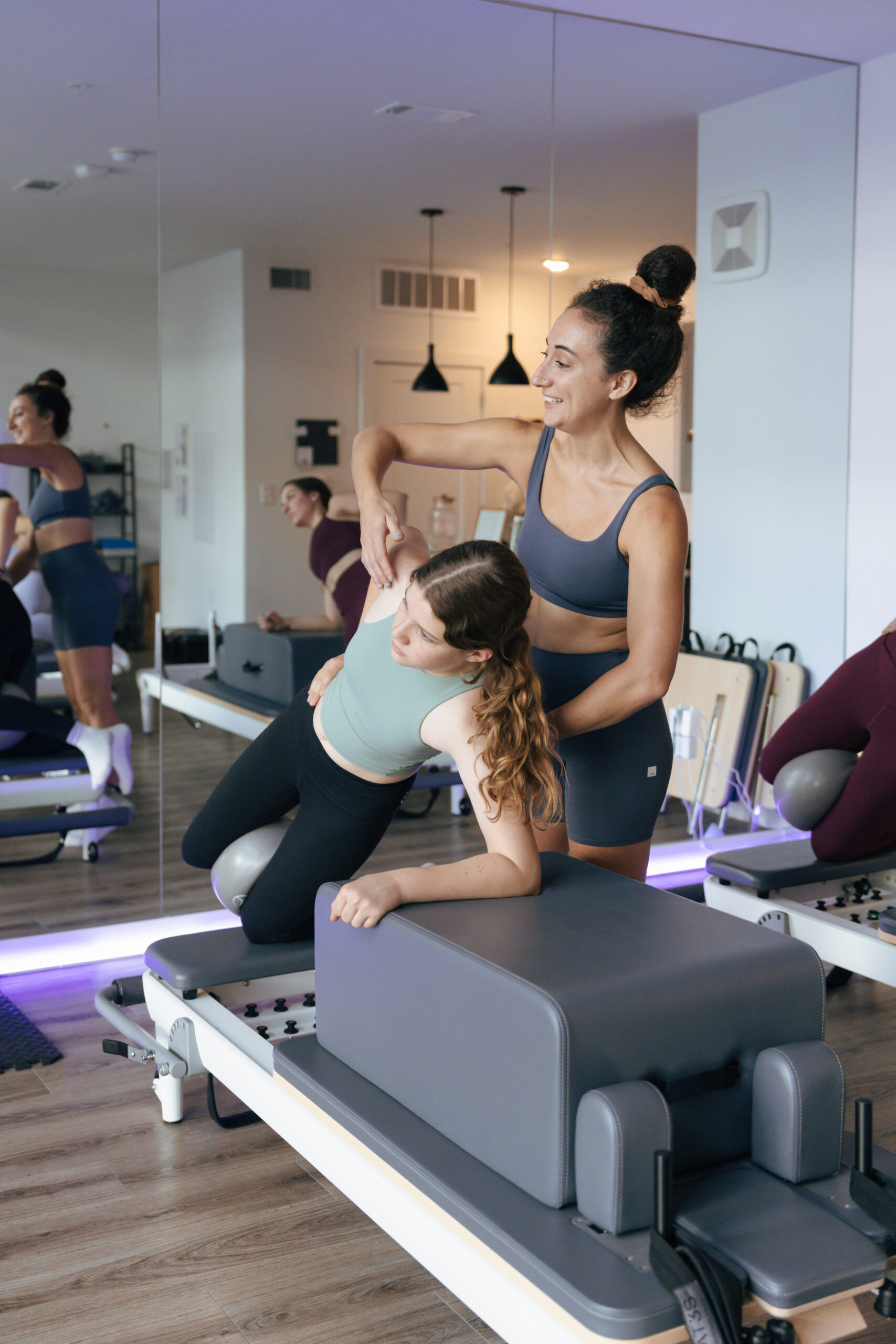
A well-trained Pilates instructor will help you identify how to work on your inner-mid range of your joint before you go closer to your joint’s hyperextended end of range. It is well worth visiting a local Pilates studio to seek out expert coaching such as this if you have the means.
What are some key takeaways for doing Pilates with hypermobility?
When doing Pilates as a hypermobile mover, props and resistance are your best friend. Why? Because adding resistance gives your hypermobile joints feedback on where your body is in space, and helps you better understand how to find your inner-mid range, instead of dumping into your end range.
For a mat Pilates practice at home, I always advise my clients to keep a theraband on hand. You can use a theraband as an add-on for side lying series to work on strengthening your hips and glutes, and for virtually any arm exercise so that you can strengthen the muscles surrounding your shoulder girdle and elbows.
-
How Pilates and Aerials Keep Your Psoas Healthy
How Pilates and aerials keep your psoas healthy. Like most areas of the body, practicing Pilates and aerials with precision has the ability to bring optimal health to the psoas- the muscle that connects your upper body to your lower body. Thoracic segment T12 and lumbar segments L1-L5 all the way down the leg towards…
-
Why Your Pilates Routine Matters Even More During the Holidays: How to Stay Consistent, and a 15 Minute Pilates Mat Flow
Pilates During the Holidays: Between travel, family gatherings, shifting schedules, and the emotional marathon of the holiday season, it’s easy for your Pilates routine to slide to the bottom of your list. But this is exactly when your practice becomes even more important. Research consistently shows that Pilates supports mental health, reduces physical tension, and…
-
Pilates for Aerialists: My Research from London
2024 was an exciting and challenging year for so many reasons! One of these reasons points to the original EMG (electromyography) research I conducted on the effect of Pilates on deep abdominal recruitment in circus artists. After spending months recruiting aerialists from different corners of the UK, 8 professional and recreational aerialists and acrobats joined…
-
Pilates for Pelvic Floor Health
It is to my delight that talking about your pelvic floor health is becoming more popular in really any setting. Even though we can’t physically see our pelvic floors, it holds so much importance from functional strength, to urinary and fecal health, sexual health and more! Having a deeper and more connected understanding on the…
-
Pilates for Happy Hips
One of the first things I notice as a Pilates instructor when one of my clients lays down on the reformer for their first exercise is the natural balance of their hips in relation to their legs, low back and deep core. Tight hip flexors, weak glutes, rotated and uneven hip crests, and a tendency…
-
Pilates Body Hack: Pilates for Rounded Shoulders
Pilates works to restore balance and equilibrium in our bodies. Unfortunately, daily life as a result of our digitally intensive work and social activities commonly brings about unwanted pain, stiffness, and imbalance. This Pilates body hack blog reveals the how behind rounded shoulders by reviewing what weak muscles cause this posture, what pain is commonly…