How Pilates Is Designed to Support Your Pelvic Floor
When most people think about the pelvic floor, they think “Kegels.”
But the truth is—your pelvic floor doesn’t work in isolation.
It’s part of a dynamic, responsive system that includes your breath, your deep abdominals, your spine, and even your hips.
This is exactly where Pilates shines.
Pilates isn’t just helpful for your pelvic floor—it was designed to support it.
Blog Guide
- Breath Re-education: The Foundation of Pelvic Floor Function
- Pilates helps create healthy pressure between your deep core, your back and your pelvic floor
- Postural Concepts in Pilates Help With Bone Stacking
- The Hip Pelvic Floor Connection- Strength Beyond Kegals
- So.. Is Pilates “Good” for your Pelvic Floor?
- Conclusion: How Pilates is Designed to Support Your Pelvic Floor
1. Breath Re-education: The Foundation of Pelvic Floor Function
Your pelvic floor and your breath are deeply connected.
Every time you inhale, your diaphragm descends, your ribcage expands, and your pelvic floor gently lengthens- and softens.
Every time you exhale, your diaphragm lifts, and your pelvic floor recoils and lifts in response.
This is a natural, reflexive relationship.
But many women (and men) lose this connection due to:
- Chronic stress (shallow chest breathing)
- Pregnancy and postpartum changes
- Holding too much tension in the core or glutes
- Years of “sucking in” the stomach
Pilates retrains this system.
Instead of forcing engagement, we teach:
- How to breathe into the ribcage three dimensionally (not just the chest or belly)
- How to allow the pelvic floor to soften on inhale
- How to feel a natural, responsive lift on exhale
This is where true strength begins—not with gripping, but with coordination.
2. Pilates helps create healthy pressure between your deep core, your back and your pelvic floor
Your core is often described as a hydraulic amplifer, scientifically, but a more helpful way to think about it is as a canister
This system includes:
- The diaphragm (top)
- The pelvic floor (bottom)
- The deep abdominals (especially transverse abdominis)
- The multifidus muscles along your spine (the deepest muscles along your spine)
When these work together, they regulate intra-abdominal pressure efficiently.
When they don’t?
That pressure has to go somewhere—and it often gets pushed into the pelvic floor.
This is where we start to see:
- Leaking
- Heaviness or pressure
- Prolapse symptoms
- Low back pain
Pilates teaches you how to distribute pressure from your diaphragm to the bottom of your pelvic floor, not dump it in either of those directions.
Through intentional movement and breath, you learn how to:
- Avoid bearing down into the pelvic floor
- Coordinate deep abdominal engagement with exhale
- Move with control instead of strain
Think of it like this:
We’re not just building strength—we’re upgrading the system that manages force and pressure in your body.
3. Postural Concepts in Pilates Help With Bone Stacking
Your pelvic floor doesn’t just respond to effort—it responds to alignment.
If your posture is compressed (think rib flare, tucked pelvis, or collapsed spine), your pelvic floor is constantly working from a disadvantaged position, instead of one that is naturally stacked.
Pilates emphasizes axial length—the idea of creating space through the spine.
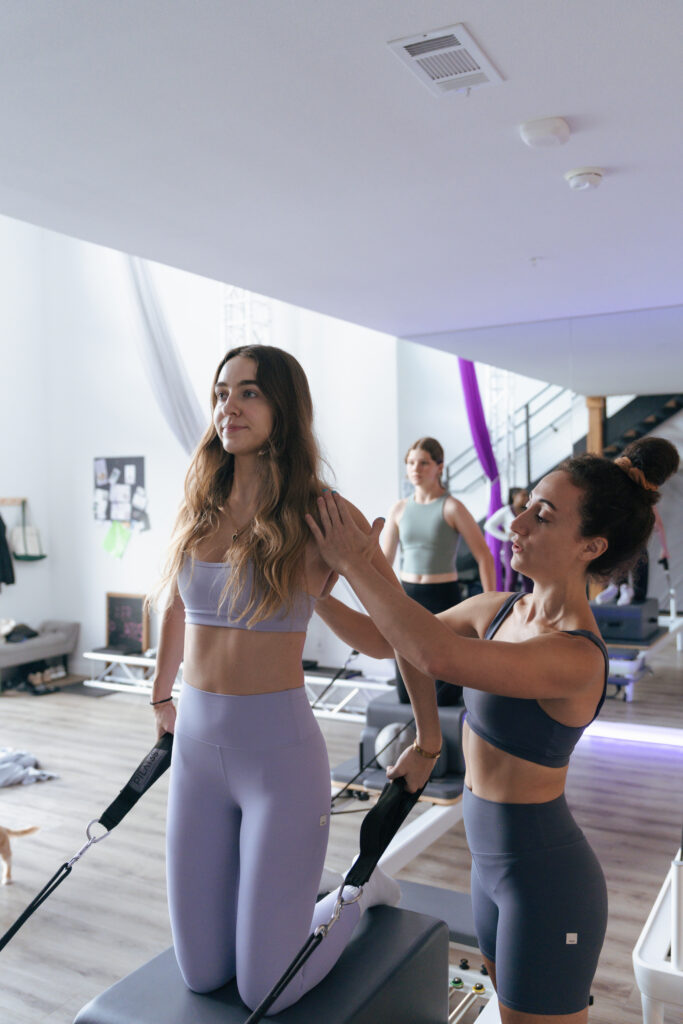
This means:
- Stacking the ribcage over the pelvis
- Allowing the spine to lengthen instead of compress
- Reducing unnecessary tension in the neck, shoulders, and lower back
When you create this kind of alignment:
- The diaphragm and pelvic floor can move more freely
- Pressure is better managed
- The pelvic floor doesn’t have to “overwork” to compensate
It’s less about “fixing posture” and more about giving your body the conditions it needs to function well.
4. The Hip–Pelvic Floor Connection: Strength Beyond Kegels
Your pelvic floor is directly influenced by the muscles around your hips.
This includes:
- Glutes
- Deep hip rotators
- Inner thighs (adductors)
- Even your hamstrings
If these muscles are weak, overactive, or poorly coordinated, your pelvic floor (and in some cases, your diaphgram) often picks up the slack.
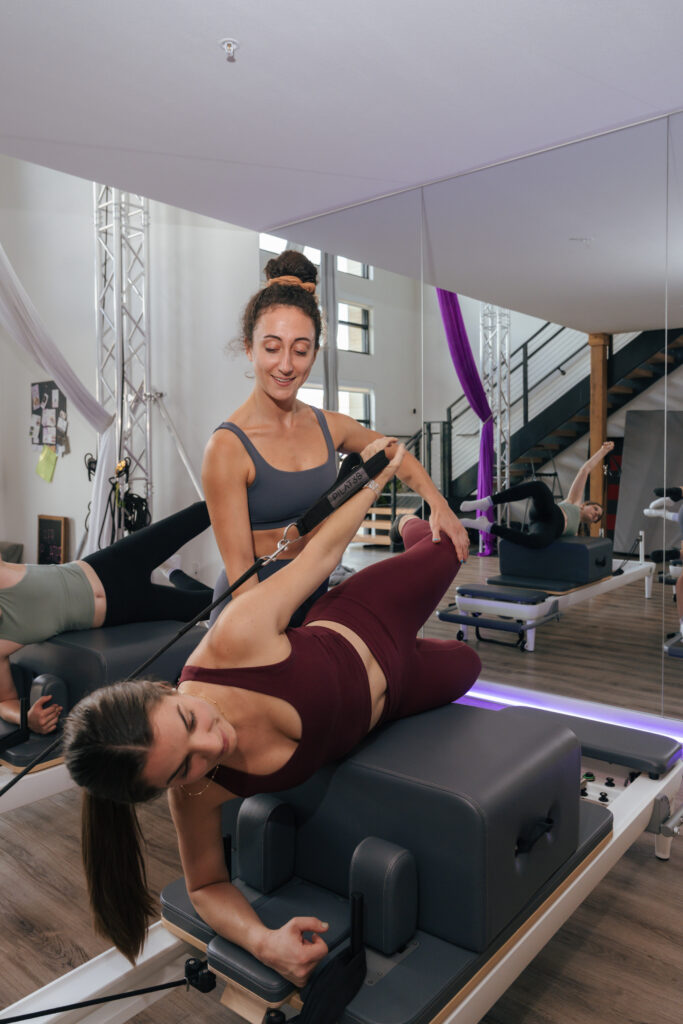
Pilates strengthens these surrounding muscles in a balanced, functional way.
Instead of isolating one area, we focus on the body as an integrated system:
- Integration — Pilates helps us build movement progressively through coordination, layering challenge with resistance, weight, and balance so the body learns to work together efficiently.
- Control through a healthy, functional range — True strength isn’t just about flexibility or intensity; it’s about being able to move with control in a range that supports your body and your goals. That range looks different for everyone.
- Stability without unnecessary gripping — We want the right muscles doing the right job. For example, during core-focused movement, the hip flexors often try to take over when the deep core should be leading the exercise. Pilates helps retrain these patterns so stability comes from balanced support rather than tension and compensation.
This is why Pilates, when it’s taught based on the foundations, often feels so different.
You’re not just working harder—you’re working smarter.
So… Is Pilates “Good” for Your Pelvic Floor?
Yes—but not for the reasons most people think.
It’s not about doing more exercises, or making it tighter, in fact in many cases, your pelvic floor is actually working too hard, and therefore too tight.
It’s about restoring the deep functioning in your body.
Pilates helps you:
- Breathe better
- Manage pressure more effectively
- Move with alignment and control
- Build strength that supports you in everything you do.
And when those pieces come together, your pelvic floor doesn’t just get stronger—it gets smarter.
Conclusion: How Pilates is Designed to Support Your Pelvic Floor
Your pelvic floor is not something to fix—it’s something to reconnect with.
And when you do, everything changes:
- How you move
- How you feel in your body
- And what you believe you’re capable of
This is the work we do every day at AER.
Not just building strength—but helping you feel at home in your body again.
-
How Pilates and Aerials Keep Your Psoas Healthy
How Pilates and aerials keep your psoas healthy. Like most areas of the body, practicing Pilates and aerials with precision has the ability to bring optimal health to the psoas- the muscle that connects your upper body to your lower body. Thoracic segment T12 and lumbar segments L1-L5 all the way down the leg towards…
-
Why Your Pilates Routine Matters Even More During the Holidays: How to Stay Consistent, and a 15 Minute Pilates Mat Flow
Pilates During the Holidays: Between travel, family gatherings, shifting schedules, and the emotional marathon of the holiday season, it’s easy for your Pilates routine to slide to the bottom of your list. But this is exactly when your practice becomes even more important. Research consistently shows that Pilates supports mental health, reduces physical tension, and…
-
Pilates for Aerialists: My Research from London
2024 was an exciting and challenging year for so many reasons! One of these reasons points to the original EMG (electromyography) research I conducted on the effect of Pilates on deep abdominal recruitment in circus artists. After spending months recruiting aerialists from different corners of the UK, 8 professional and recreational aerialists and acrobats joined…
-
Pilates for Pelvic Floor Health
It is to my delight that talking about your pelvic floor health is becoming more popular in really any setting. Even though we can’t physically see our pelvic floors, it holds so much importance from functional strength, to urinary and fecal health, sexual health and more! Having a deeper and more connected understanding on the…
-
Pilates for Hypermobility
Hypermobility is a condition of the joints that affects more people than the majority of the population realizes. Several of my Pilates clients have been somewhat unaware of their hypermobility until I drew attention to it within our sessions and explained the range of motion that each joint is ideally designed to move through. If…
-
Pilates for Happy Hips
One of the first things I notice as a Pilates instructor when one of my clients lays down on the reformer for their first exercise is the natural balance of their hips in relation to their legs, low back and deep core. Tight hip flexors, weak glutes, rotated and uneven hip crests, and a tendency…